Restaurant Food Safety Case Study
A line check before dinner: from food-safety exception to corrective action
A pre-service check finds a problem while there is still time to respond. Here is what the team records, how the manager follows up, and why the digital history matters after the shift ends.
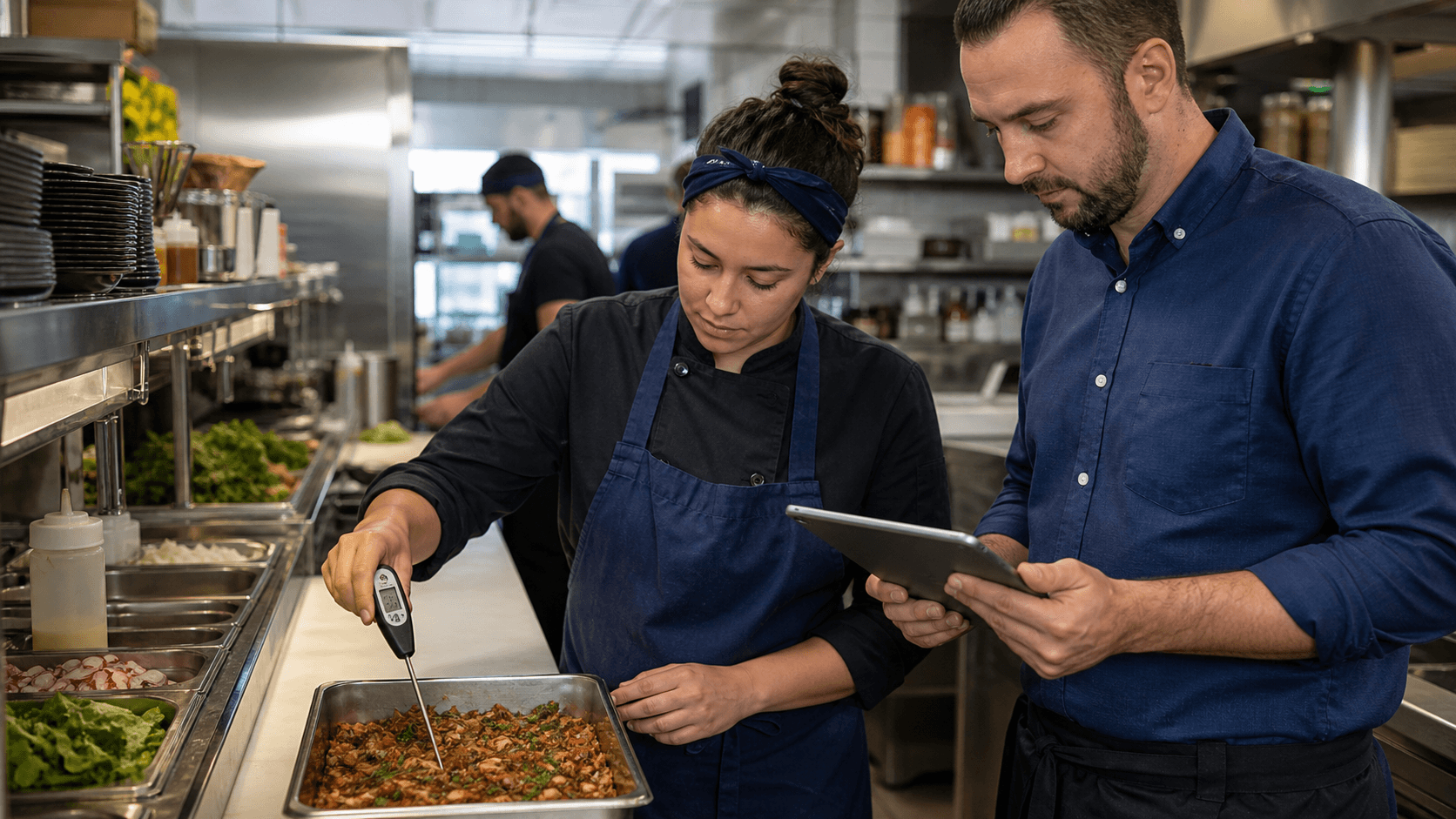
A useful check connects a measured condition with a timely response.
The value of a line check is easiest to see when something is wrong. A checkmark does not protect the shift. A team member noticing an exception, recording what they found, following the approved response, and verifying the result creates the real protection.
The setting: a busy handoff before dinner
The restaurant is moving from afternoon prep into dinner service. The cold line has been stocked, team members are changing positions, and the manager is balancing deliveries, callouts, and opening the dining room. It is exactly the kind of transition where a small miss can become invisible once tickets start printing.
The pre-service line check asks for observable conditions rather than a general “station ready” answer. The employee records actual temperatures, confirms labels and product condition, notes anything missing, and flags an exception for manager review.
That approach reflects the FDA's active-managerial-control framework: establish the control, monitor it, take corrective action when needed, and verify that the process is working.FDA Food Code 2022
What happened during the check
The timeline below is illustrative, but each step represents a practical part of a strong line-check workflow.
The station check begins
The assigned employee opens the cold-line check and works through each item in sequence instead of relying on memory.
A reading falls outside the approved limit
A measured food temperature does not meet the limit established for that item and operation. The employee records the actual reading rather than marking the station complete.
The manager reviews the exception
The manager protects the product and follows the restaurant's approved corrective-action procedure. Nearby products and the equipment condition are also checked so the team does not treat one reading as an isolated box.
A second, lower-risk miss is corrected
The same check identifies an incomplete label. The employee corrects it before service and records the follow-up.
The check closes with a usable record
The digital history shows who completed the check, when it happened, how long it took, what failed, and what the team did next.
The success was not finding a perfect station.
It was finding an exception before service, responding through the restaurant's approved procedure, and preserving enough context for the manager to learn from it later.
Why the temperature check matters
CDC identifies time and temperature control as an important part of understanding restaurant outbreak contributing factors. Food held at the wrong temperature for long enough can allow harmful bacteria to grow, while inadequate cooking time or temperature can allow pathogens to survive.CDC contributing factors
The digital checklist does not decide whether food is safe. The restaurant must establish limits and corrective actions that match its process and the rules adopted by its jurisdiction. The checklist makes that operating expectation visible at the moment someone must measure and respond.
The next-day review creates the longer-term value
After the immediate correction, the manager reviews the completed check. The record answers questions that a final checkmark cannot: Was the exception found before service? Was the reading recorded? Who responded? How long did the full station check take? Was another item affected?
One exception may be a one-time miss. Repeated exceptions at the same station, time, or item point toward a cause worth investigating: how the line is stocked, whether equipment is recovering properly, whether the check timing is appropriate, or whether the team needs clearer training.
That is where digital restaurant line check software adds value beyond replacing paper. It turns separate shift observations into a history managers can review for coaching and operational patterns.
Five lessons from the case
Measure the condition
Ask for the actual reading or observable result—not “everything okay.”
Make exceptions visible
A failed item should be easy for the employee to record and for the manager to review.
Connect failure to action
Define the approved response before the shift becomes busy.
Preserve who and when
Time stamps and ownership make follow-up specific and fair.
Review patterns
Use repeated exceptions to improve equipment, prep, training, or check timing.
What this case study does not claim
A line check cannot guarantee that no foodborne illness will occur. It does not replace manager observation, employee illness policies, training, calibrated thermometers, required HACCP procedures, or the food-safety code adopted by the local jurisdiction.
It can give those controls a repeatable place in the shift. When the check is specific, timely, and connected to corrective action, it helps the team catch an ordinary miss before it becomes harder to manage.
Sources and further reading
The operational scenario is a transparent composite. Food-safety context was checked against current federal guidance available when published.
- Contributing Factors in Restaurant Foodborne Illness Outbreaks
Centers for Disease Control and Prevention · May 7, 2024
- Food Code 2022 — Management of Food Safety Practices
U.S. Food and Drug Administration · Current edition with supplement corrections
About this case study: This is a representative composite based on recurring situations encountered in restaurant operations. It is not presented as a named customer, a single documented incident, or a measured product outcome. Times and identifying details are illustrative.
Make every check actionable