Food Safety & Operations
Why line checks matter: safer food, completed tasks, and cleaner locations
The most damaging misses are often small, routine, and invisible from the office. A good line check gives every shift a practical way to catch them while there is still time to act.
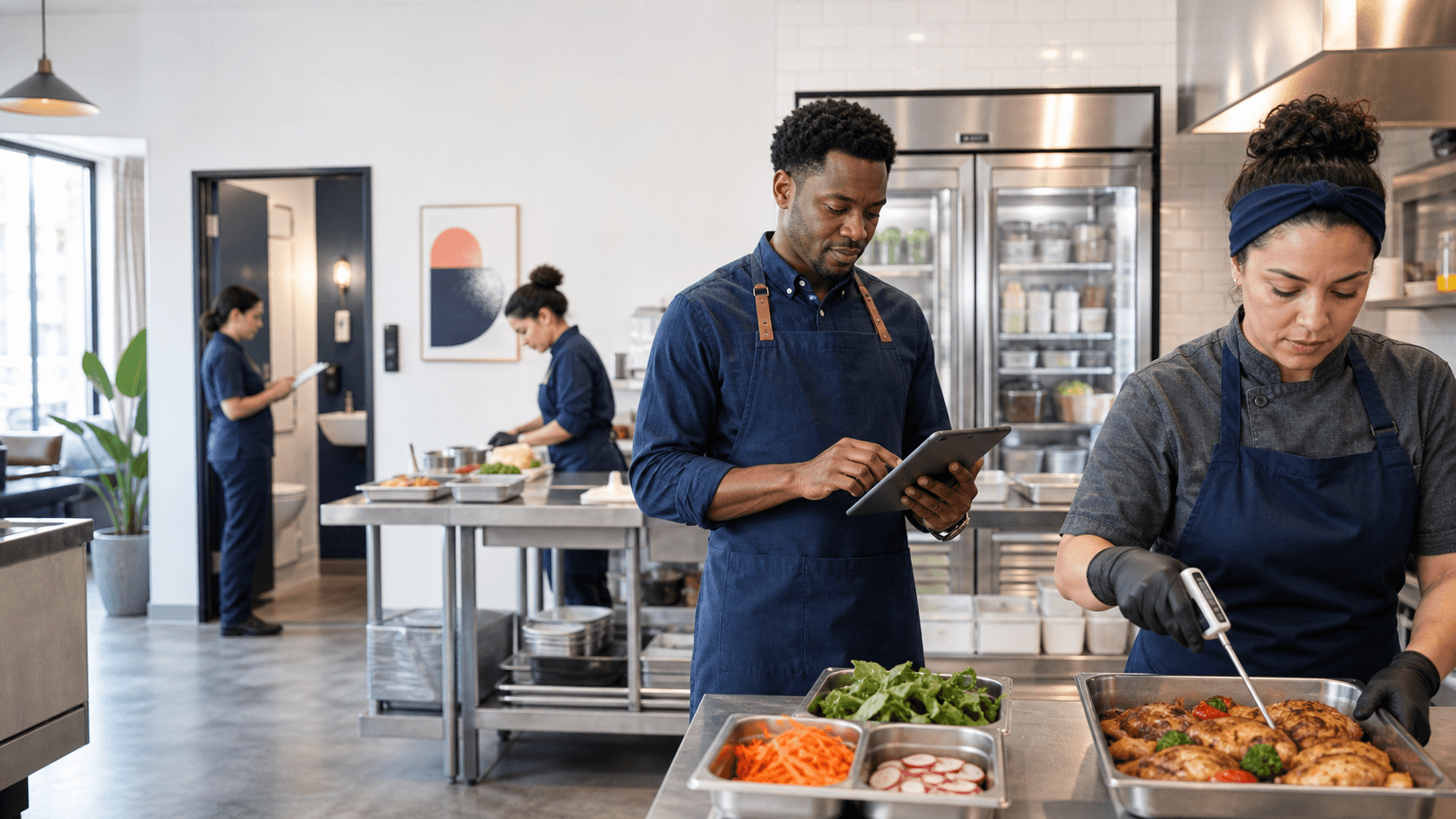
Routine verification connects food safety, shift execution, and facility care.
A line check is a short, repeatable verification of the conditions that must be right during a shift: temperatures, labels, sanitation, stocked hand sinks, clean restrooms, safe sales floors, and completed opening or closing work. Its real value is not the checkmark. It is the chance to find a problem, assign an owner, and confirm the correction.
1 in 3
times restaurant workers washed their hands when they should have in CDC observations
20.9%
of bacterial outbreaks in 2020–2022 included inadequate initial cooking time/temperature as a contributing factor
17.3%
of bacterial outbreaks in 2020–2022 included improper cooling as a contributing factor
Food safety fails in the gap between knowing and doing
Most teams know that food must be cooked, cooled, held, and stored safely. The operational problem is whether those controls are actually verified during a busy Tuesday lunch, a short-staffed close, or a manager handoff.
The CDC's 2025 analysis of reported outbreaks found that inadequate cooking temperatures and improper cooling remained important contributing factors in bacterial outbreaks. The report specifically notes that cooling practices can be validated by reviewing logs, confirming that a working thermometer is available, talking with employees, and observing the process. That is line-check thinking: do not assume the process happened—verify it.CDC MMWR, 2025
Hand hygiene has the same execution gap. CDC restaurant observations found that workers washed their hands when they should about one-third of the time. Time pressure, sink accessibility, training, and management emphasis all influenced the behavior. A line check cannot prove every handwash occurred, but it can confirm that sinks are accessible and stocked, prompt direct observation, and make coaching part of the shift.CDC restaurant handwashing findings, 2024
For retail teams, visibility creates accountability
In a single location, an experienced manager may notice an unfinished task. Across five, twenty, or one hundred locations, memory and walk-throughs do not scale. Leaders need a consistent record of what was expected, who checked it, when it was checked, what failed, and whether the failure was corrected.
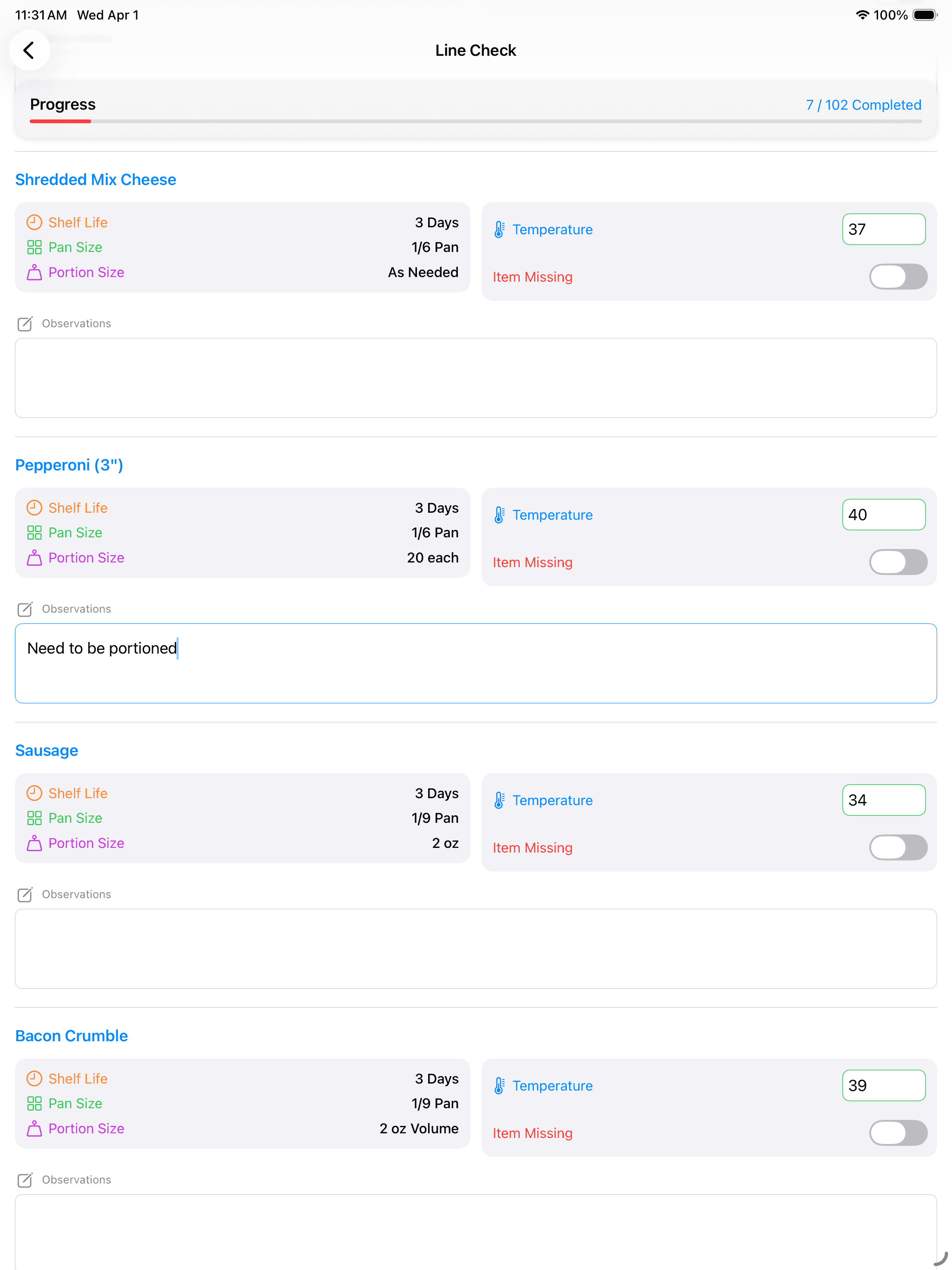
That applies beyond kitchens: opening cash controls, promotional displays, exit access, cooler temperatures, spill hazards, fitting rooms, and closing security checks can all disappear into the space between a written procedure and a completed shift. Using digital restaurant line check software turns those expectations into the same observable workflow at every store.
This consistency mirrors a benefit the FDA identifies for Food Code adoption: uniform standards reduce complexity and support more standardized inspections and audits. The same operating principle works inside a brand—standardize the expectation, then make exceptions easy to see.FDA Food Code 2022
Restrooms are operational blind spots, not side work
Restrooms are easy to neglect because they sit outside the normal line of sight. Guests experience them directly, employees use them throughout the shift, and managers may not enter them often enough to catch a problem early. A vague instruction to “check the bathroom” makes the result depend on each person's definition of clean.
The FDA Food Code is more direct: toilet facilities should be kept clean and in good repair to help prevent contamination and encourage sanitary practices. CDC guidance for food-service workers also emphasizes proper handwashing after using the restroom. Treating the restroom as part of the operating system—not an afterthought—connects guest experience with employee hygiene.FDA Food Code § 6-501.18CDC Shigella prevention guidance, 2024
A stronger restroom check names observable conditions: soap and paper stocked, fixtures and touchpoints clean, floors dry, waste below capacity, odors addressed, and repairs reported. If something fails, the check should identify an owner and a recheck time.
What a useful line check looks like
The best checklist is not the longest one. It is short enough to complete, specific enough to produce the same answer from different people, and connected to action when something is wrong.
- 1
Ask for an observable condition
Replace “cooler okay” with the product or equipment to check, the approved limit for that operation, and the reading to record.
- 2
Match frequency to risk
High-risk temperature and sanitation controls may need checks during the shift; slower-changing facility conditions may need a different cadence.
- 3
Capture evidence where it helps
Use measured values, notes, or photos for exceptions. Evidence should make the result clearer, not create busywork.
- 4
Make failures start a workflow
A failed item should trigger the corrective action, owner, escalation path, and verification that the problem is actually closed.
- 5
Review patterns, not only completion
A 100% completion rate can hide repeated failures. Look for recurring items, locations, shifts, and times so training or maintenance addresses the cause.
| Area | Verify | Capture | If it fails |
|---|---|---|---|
| Cold holding | Selected food is within the locally required limit | Actual temperature | Protect product and follow the approved corrective action |
| Hand sink | Accessible, supplied, and operating | Pass/fail plus exception note | Restock or repair; coach as needed |
| Restroom | Fixtures and touchpoints clean; floor dry; supplies stocked | Exception note or photo | Assign cleaning or maintenance, then recheck |
| Retail floor | Required display, clear exits, and no visible trip hazards | Pass/fail by zone | Correct or escalate before opening |
A completed checklist is not the outcome. A corrected risk is.
Measure line-check quality by what the team catches, how quickly it responds, and whether the same issue becomes less common over time.
Sources and further reading
Claims in this article were checked against current federal public-health guidance and surveillance available when it was published.
- Contributing Factors of Foodborne Illness Outbreaks — United States, 2014–2022
CDC Morbidity and Mortality Weekly Report · March 13, 2025
- Food Worker Handwashing in Restaurants
Centers for Disease Control and Prevention · March 18, 2024
- Food Code 2022
U.S. Food and Drug Administration · Current edition, with December 2024 supplement corrections
- Preventing Shigella Infection Among Food Service Workers and Managers
Centers for Disease Control and Prevention · March 5, 2024
Make every shift verifiable